
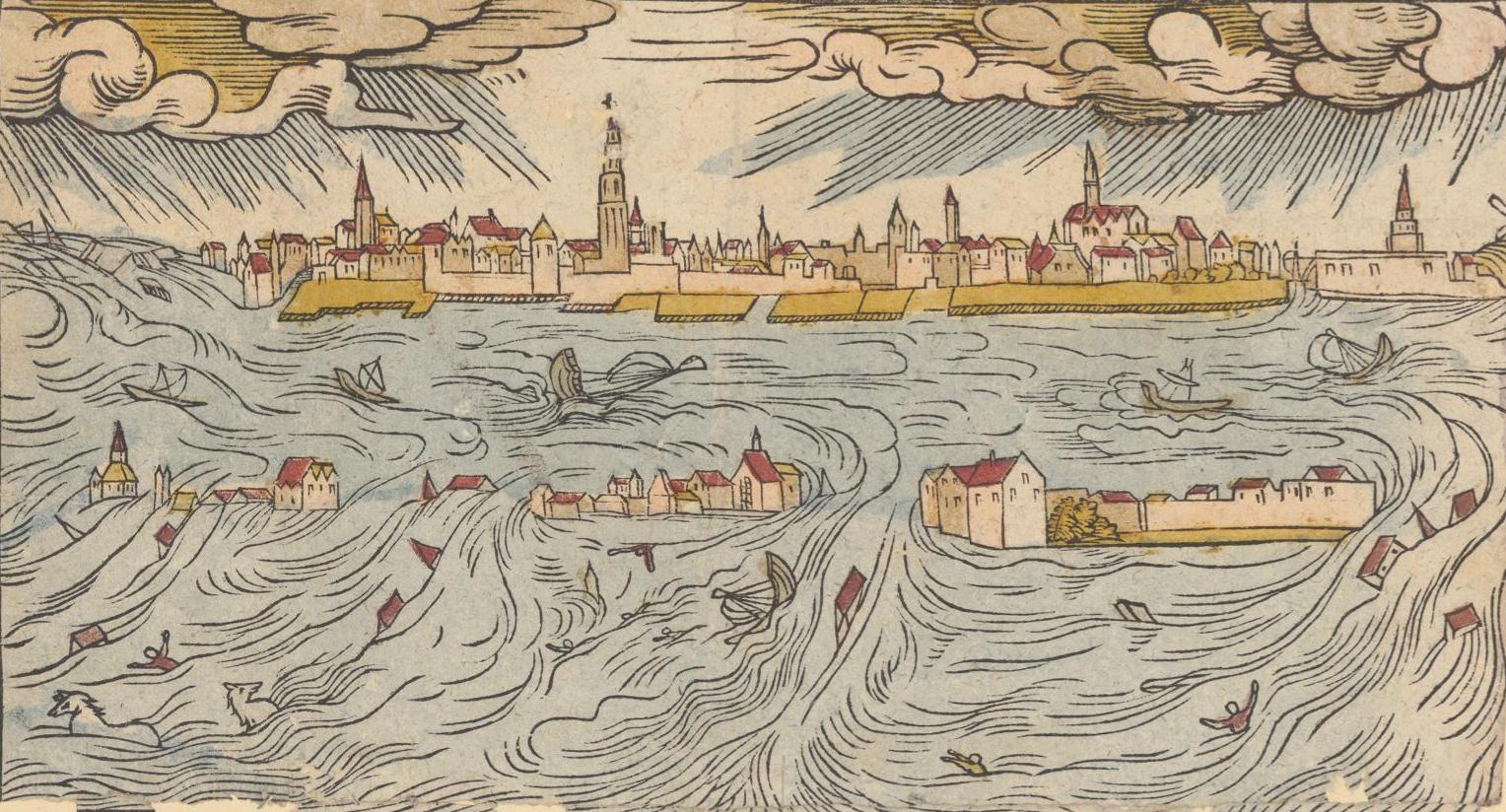
Holtzman: Antwerp Flood, 1 Nov. 1570 ·
© Zentralbibliothek Zürich, Public Domain
Emmy Noether Research Group · DFG
Traces
of the ›Little Ice Age‹
in Early Modern
Literature
Project Background
The Project
Emmy Noether Junior Research Group · Funding start: October 2024 · Head: Jun.-Prof. Dr. Joana van de Löcht
Temperature reconstructions from historical sources, dendrochronological and palaeobotanical data, as well as sediment analyses and ice cores, show that the warming of the climate marking the onset of the industrial age was preceded by a long cold phase spanning the last 1000 years – the so-called ‚Little Ice Age’ (c. 1350–1850; LIA). While the temperature trends and historical consequences of the ‚Little Ice Age’ have already been largely established, research into its cultural impact remains a desideratum. Within the project, which can be situated in the environmental humanities, we aim to determine – through both contextualising-interpretive methods and technically supported analyses – whether and to what extent the adverse climatic conditions of the ‚Little Ice Age’ affected the development of literature in general, and in particular the genres and thematic choices of texts between the second half of the 16th and the second half of the 18th century. Furthermore, in workshops and a colloquium held in exchange with interdisciplinary cooperation partners, the scope will be extended to the late Middle Ages and the 19th century.
In its temporal scope, the project follows the peak phases of the ‚Little Ice Age’ – it takes a cold period identified by climate historians as its basis for dating, while the textual analysis also includes examples from periods of more favourable environmental conditions in order to make differences and continuities visible. Since awareness of the mutability of climate is a recent phenomenon, weather – always perceptible to people and documented in texts – lends itself as the primary object of investigation. Weather is not regarded here as an isolated phenomenon, but is always placed within a broader discursive context of weather explanations and weather consequences. Through this diachronic approach, discursive changes are to become visible – such as the influence of an emerging quantitative meteorology in the late 17th century, as well as the persistence of ‚disaster memories’ and possible habituation and resilience effects within the period under study. The project thus contributes to research on cultural coping and adaptation strategies in response to climate-related extreme events and prolonged adverse environmental conditions.